Exam VNX301 Course, Latest VNX301 Test Dumps
Wiki Article
For candidates who are going to buy VNX301 exam dumps online, the safety for the website is quite important. If you choose us, we will provide you with a clean and safe online shopping environment. We have professional technicians to check the website at times, therefore the website safety can be guaranteed. In addition, VNX301 Exam Materials of us contain both questions and answers, and you can have a quickly check after practicing. We have online and offline chat service for VNX301 training materials. If you have any questions, you can contact with us, and we will give you reply as soon as possible.
Their updated Versa Certified SD-WAN Specialist (VNX300) (VNX301) practice test material includes the latest and real VNX301 questions that are very similar to those given in the actual Versa Certified SD-WAN Specialist (VNX300) (VNX301) exam. Additionally, the Versa Certified SD-WAN Specialist (VNX300) (VNX301) practice test software creates a realistic VNX301 exam environment for users, and it also helps you in your preparation for the actual Versa Certified SD-WAN Specialist (VNX300) (VNX301) test. Prep4pass offers the latest VNX301 exam questions in multiple formats for convenience. These formats include Versa Certified SD-WAN Specialist (VNX300) (VNX301) copyright, VNX301 Practice Test (web-based), and VNX301 Practice Exam Software (Desktop-Based).
Latest VNX301 Test Dumps - VNX301 Exam Dumps.zip
So, when you get the Versa Certified SD-WAN Specialist (VNX300) VNX301 exam dumps material for your Versa Certified SD-WAN Specialist (VNX300) VNX301 certification exam, you have to check whether they are providing you the Versa Certified SD-WAN Specialist (VNX300) VNX301 Practice Test or not. You must choose those who shall give you the Versa Certified SD-WAN Specialist (VNX300) VNX301 questions and not those who are giving you copied sheets only.
Versa Networks VNX301 Exam Syllabus Topics:
| Topic | Details |
|---|---|
| Topic 1 |
|
| Topic 2 |
|
| Topic 3 |
|
Versa Networks Versa Certified SD-WAN Specialist (VNX300) Sample Questions (Q13-Q18):
NEW QUESTION # 13
Which two statements are true about templates? (Choose two.)
- A. You must have at least one service template per appliance.
- B. You can use a Workflow Template to create new device templates.
- C. You can have more than one device template per appliance.
- D. You can use variables in a template to allow devices to have unique values.
Answer: B,D
Explanation:
The correct answers are C and D . Versa templates are designed to reuse common configuration while still allowing per-device customization. Template variables allow the same template to be deployed to multiple appliances while using device-specific values such as addresses, VLAN IDs, DHCP information, or other bind-data values. Versa documentation for deploying templates describes assigning values to variables contained in a main template that are specific to the device. This makes option C correct.
Option D is also correct because Versa workflows are used to create templates for VOS device configuration.
Versa documentation states that workflows are used to create templates to configure VOS devices, and also to create templates for application steering, spoke groups, and service chains.
Option A is not correct in the normal Versa Director onboarding model because a group of devices is associated with one staging template and one post-staging template, rather than multiple device templates being stacked per appliance. Option B is also incorrect because service templates are optional reusable service-specific fragments. Versa documentation states that service templates can be used by multiple device templates and device groups, but it does not require every appliance to have one.
NEW QUESTION # 14
An SD-WAN branch is deployed behind a NAT device. In the VSM local-tunnel-site output, which field or flag indicates that a WAN link is behind NAT?
- A. Tenant ID only
- B. WAN lcl vrf-id only
- C. WAN lcl link behind NAT or BN flag
- D. Neighbour site type only
Answer: C
Explanation:
The correct answer is A . Versa SD-WAN data-path troubleshooting documentation shows the VSM local- tunnel-site output and includes a legend in which BN means Behind NAT . In the WAN local link details, the output also displays a field named WAN lcl link behind NAT , with values such as 1 or 0, and link flags including [ BN CT PT SLA-P ] when the WAN link is behind NAT.
This information is important because NAT status affects how SD-WAN tunnel endpoints are discovered and how public and private transport addresses are represented. The same output includes both public and private WAN link addresses, making it useful for troubleshooting sites behind NAT, stale tunnel endpoints, or incorrect public-address learning.
WAN lcl vrf-id identifies the local transport routing instance ID, not NAT status. Tenant ID identifies the tenant context. Neighbour site type identifies whether the remote endpoint is a Controller, hub, or SD-WAN site. None of those fields specifically confirms whether the local WAN transport is behind NAT.
NEW QUESTION # 15
You are asked to ensure symmetric traffic flows between two SD-WAN branches. Which feature should be enabled to achieve this objective?
- A. Symmetric Routing
- B. Packet Striping
- C. Equal-Cost Multipath
- D. Symmetric Forwarding
Answer: D
Explanation:
Symmetric Forwarding is the correct Versa SD-WAN feature for ensuring that return traffic between SD- WAN branches follows the same SD-WAN path on which the forward traffic was received. Versa documentation for SD-WAN traffic steering describes Symmetric forwarding as the option that specifies the path for reverse-direction traffic, meaning whether traffic returning from the destination branch to the originating branch should be sent on the same path on which it arrived. It further states that enabling symmetric traffic forwarding determines the reverse path for traffic returning from the destination branch to the originating branch.
This is different from Symmetric Routing, which is a routing design goal or behavior, not the Versa SD- WAN forwarding-profile feature named in the product documentation. Equal-Cost Multipath can distribute flows across equal-cost routes, but it does not specifically guarantee that both directions of the same SD-WAN session use the same path. Packet Striping is used to split or distribute packets across multiple links for performance, not to enforce bidirectional path symmetry. Therefore, the verified Versa feature to enable is Symmetric Forwarding.
NEW QUESTION # 16
Examine the exhibit below.
Which two statements correctly explain the routing shown in the exhibit. (Choose two.)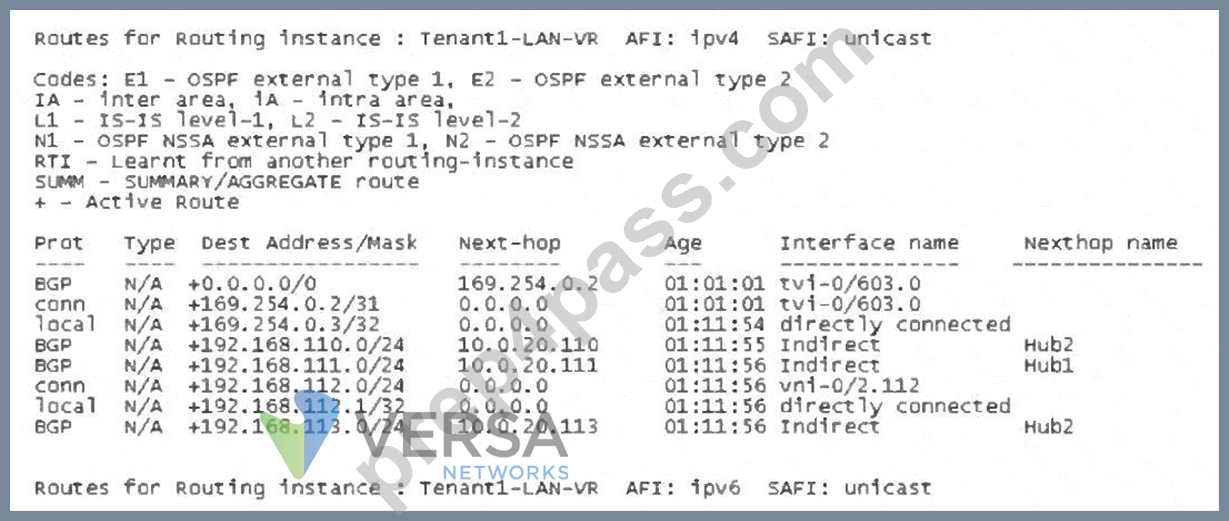
- A. The tvi-0/603 interface is paired with an interface in another VR for the default route.
- B. The IP address configured on the tvi-0-603 interface its misconfigured by the template.
- C. The tvi-0/603 interface is a stub interface for black holing an unknown IP unicast destination.
- D. Any unknown IP unicast destination will use the tvi-0/603 interface for its exit.
Answer: A,D
Explanation:
The correct answers are A and C . The route table shown in the Versa SD-WAN design documentation includes a default route, 0.0.0.0/0 , with next hop 169.254.0.2 and exit interface tvi-0/603.0 . A default route is used when no more specific route exists in the routing table, so any unknown IPv4 unicast destination will follow that active default route through the tvi-0/603 interface. This directly supports option C.
The same design context describes local or central internet breakout, where Director workflows create TVI- based connectivity for breakout or gateway-style forwarding. In Versa SD-WAN, TVI interfaces are commonly used as internal virtual tunnel interfaces between routing instances, such as between a tenant LAN VR and a transport or breakout VR. The documentation also describes virtual TVI interface pairs being created by Director workflows between VRs for gateway routing use cases. Therefore, option A is also correct: tvi-0/603 is paired with another interface in another VR to support the default-route forwarding path.
The IP address is not shown as misconfigured; 169.254.x.x addressing is commonly used for point-to- point internal TVI links. The route is also not a blackhole route, because it has an active next hop and an exit interface.
NEW QUESTION # 17
A branch has Direct Internet Access enabled. Users can resolve DNS, but application traffic fails. You find that the internet speed test also fails to fetch the server list. Which two configurations should be checked first?
- A. OSPF area ID and BGP MED
- B. SNMP community and syslog server
- C. CGNAT and DNS configuration
- D. VRRP priority and DHCP lease time
Answer: C
Explanation:
The correct answer is A . Versa documentation for internet speed tests states that before running an internet speed test, administrators must verify WAN internet connectivity and verify that CGNAT is configured on the provider organization. It also states that administrators should verify that they can retrieve the list of predeployed internet speed-test servers. If an error occurs while fetching the server list, the documentation instructs administrators to check the CGNAT and DNS configurations and then click Fetch Server List again.
This aligns with the scenario because DNS resolution and internet breakout depend on correct DNS reachability, NAT translation, and routing through the internet-facing transport. Even if DNS appears partially functional, CGNAT misconfiguration can still prevent application or HTTP test traffic from completing properly.
OSPF, BGP MED, SNMP, syslog, VRRP, and DHCP may be important in other designs, but they are not the first items Versa identifies for a failed internet speed-test server-list fetch in a DIA context.
NEW QUESTION # 18
......
Our product boosts many merits and functions. You can download and try out our VNX301 test question freely before the purchase. You can use our product immediately after you buy our product. We provide 3 versions for you to choose and you only need 20-30 hours to learn our VNX301 training materials and prepare the exam. The passing rate and the hit rate are both high. The purchase procedures are safe and we protect our client’s privacy. We provide 24-hours online customer service and free update within one year. If you fail in the exam, we will refund you immediately. All in all, there are many advantages of our VNX301 Training Materials.
Latest VNX301 Test Dumps: https://www.prep4pass.com/VNX301_exam-copyright.html
- 100% Pass Quiz VNX301 - Versa Certified SD-WAN Specialist (VNX300) –Professional Exam Course ???? The page for free download of ➡ VNX301 ️⬅️ on ( www.examcollectionpass.com ) will open immediately ????Trustworthy VNX301 Source
- Valid VNX301 Test Guide ???? Valid Test VNX301 Bootcamp ???? VNX301 New APP Simulations ???? Easily obtain free download of ➡ VNX301 ️⬅️ by searching on 「 www.pdfvce.com 」 ????VNX301 Download
- VNX301 Valid Exam Cost ???? VNX301 Labs ???? VNX301 Valid Exam Cost ???? Download ( VNX301 ) for free by simply searching on [ www.verifieddumps.com ] ????VNX301 Relevant Exam Dumps
- VNX301 Actual Lab Questions - VNX301 Certification Training - VNX301 Pass Ratio ???? Open 《 www.pdfvce.com 》 enter ➡ VNX301 ️⬅️ and obtain a free download ????VNX301 Prep Guide
- Free PDF Exam VNX301 Course | Perfect Latest VNX301 Test Dumps: Versa Certified SD-WAN Specialist (VNX300) ???? Download ➽ VNX301 ???? for free by simply searching on “ www.dumpsmaterials.com ” ????VNX301 Actual Dumps
- Study VNX301 Materials ???? VNX301 Valid Exam Cost ???? VNX301 Customizable Exam Mode ???? Copy URL ➤ www.pdfvce.com ⮘ open and search for ( VNX301 ) to download for free ????VNX301 Actual Dumps
- VNX301 Relevant Exam Dumps ???? Exam VNX301 Duration ???? Valid VNX301 Test Guide ???? Open ➡ www.practicevce.com ️⬅️ and search for ▛ VNX301 ▟ to download exam materials for free ????VNX301 Certification Dumps
- Latest Updated Exam VNX301 Course - Versa Networks Latest Versa Certified SD-WAN Specialist (VNX300) Test Dumps ???? Simply search for 「 VNX301 」 for free download on ▛ www.pdfvce.com ▟ ????Exam VNX301 Duration
- 2026 100% Free VNX301 –Professional 100% Free Exam Course | Latest Versa Certified SD-WAN Specialist (VNX300) Test Dumps ???? Search for ➤ VNX301 ⮘ and download exam materials for free through 【 www.prep4away.com 】 ????Exam VNX301 Duration
- Hot Exam VNX301 Course | Reliable Latest VNX301 Test Dumps: Versa Certified SD-WAN Specialist (VNX300) 100% Pass ???? Search for ➥ VNX301 ???? and obtain a free download on ▷ www.pdfvce.com ◁ ????VNX301 Actual Dumps
- Study VNX301 Materials ⏭ VNX301 Prep Guide ???? Study VNX301 Materials ???? Open 【 www.validtorrent.com 】 and search for 《 VNX301 》 to download exam materials for free ????Exam VNX301 Duration
- pr1bookmarks.com, tiannacoiw553460.activablog.com, geniusbookmarks.com, www.stes.tyc.edu.tw, aliciaaopa282558.westexwiki.com, socialmediatotal.com, bbsocialclub.com, gorillasocialwork.com, keithstmj535068.wikiparticularization.com, bookmarkpath.com, Disposable vapes